Thaki Cloud Presents AI Service Reference Architecture
Framework distinguishes between enterprise AI environments and AI cloud providers, covering data protection, operations automation and token-based capacity planning AI cloud provider architecture adds requirements for tenant isolation, billing, SLAs and self-service delivery
Thaki Cloud has presented an AI Service Reference Architecture designed to help enterprises and AI cloud providers plan and operate production AI services. The architecture distinguishes between organizations using AI for internal business functions and providers delivering AI infrastructure and services to external customers, while defining the design principles and operational requirements shared by both environments.
According to Thaki Cloud, many traditional service architecture principles still apply to AI. However, AI services introduce different priorities around capacity planning, cost structure, data sensitivity and quality validation. Traditional services are often sized primarily around user counts and peak traffic, while AI services must also account for token consumption per task and the processing throughput required to support that demand.
The cost structure is also different. GPU resources, power consumption and token throughput can become major operating factors, while prompts and business context may contain personal or internal company data. AI services also require evaluation of model responses in addition to conventional functional testing.
Routing workloads according to data sensitivity
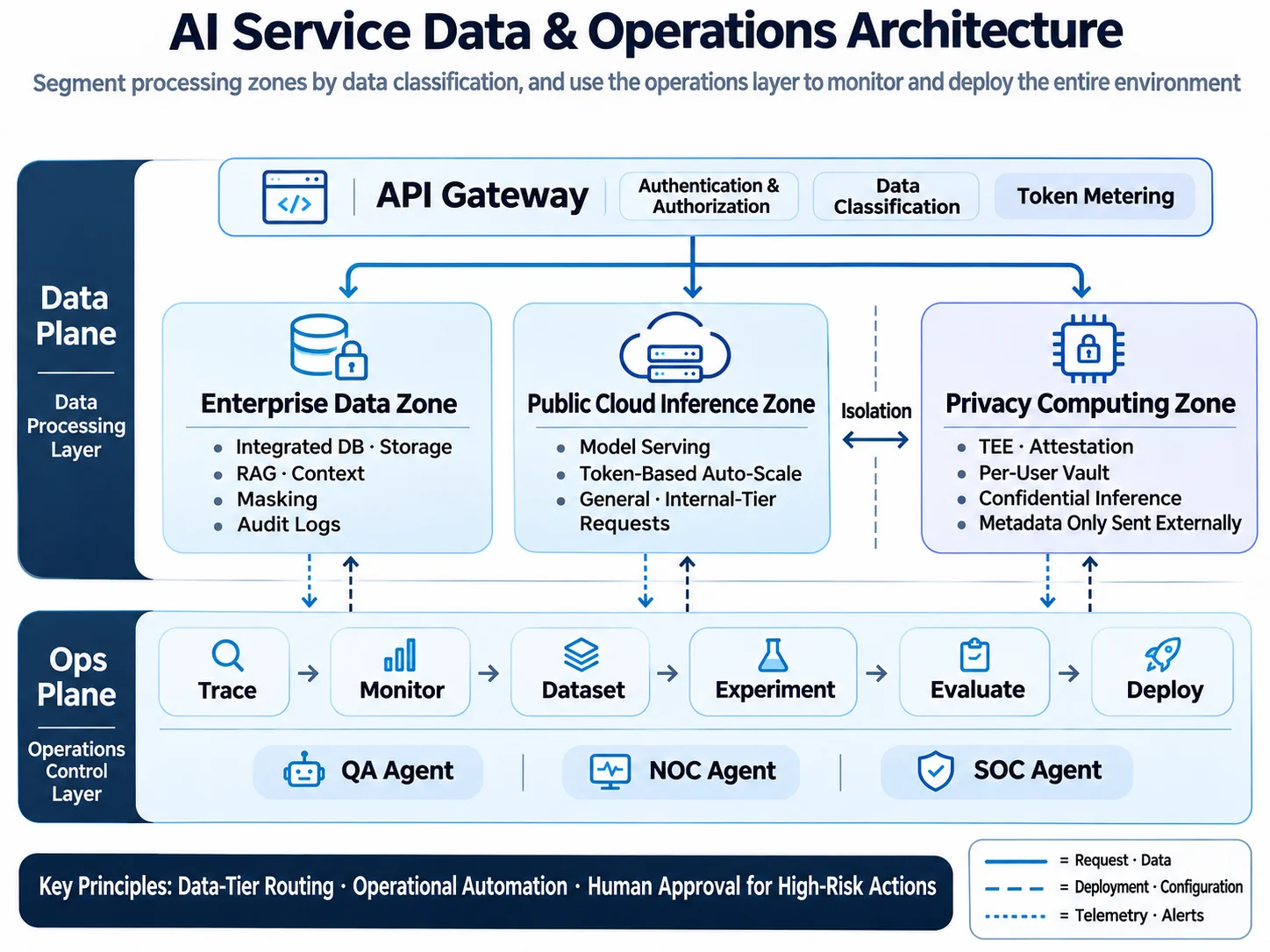
The reference architecture separates an AI service environment into a Data Plane, which processes requests and data, and an Ops Plane, which manages and controls the service.
Within the Data Plane, an API gateway authenticates requests, determines their data classification and routes them to the appropriate processing environment. Business context and internal data can remain within the enterprise's protected environment, while variable general inference workloads may use public cloud resources. For information that must remain inaccessible even to the service provider, the architecture proposes a separate privacy-computing environment.
The Ops Plane covers observability, model evaluation, dataset development, CI/CD and operational automation. AI agents can support QA, network operations and security operations, while irreversible or high-risk actions remain subject to human approval.
The architecture identifies 16 common requirements spanning areas including data residency, AI guardrails, identity and access integration, data deletion, disaster recovery, cost management and model portability.
Enterprise AI and AI cloud services require different operating standards
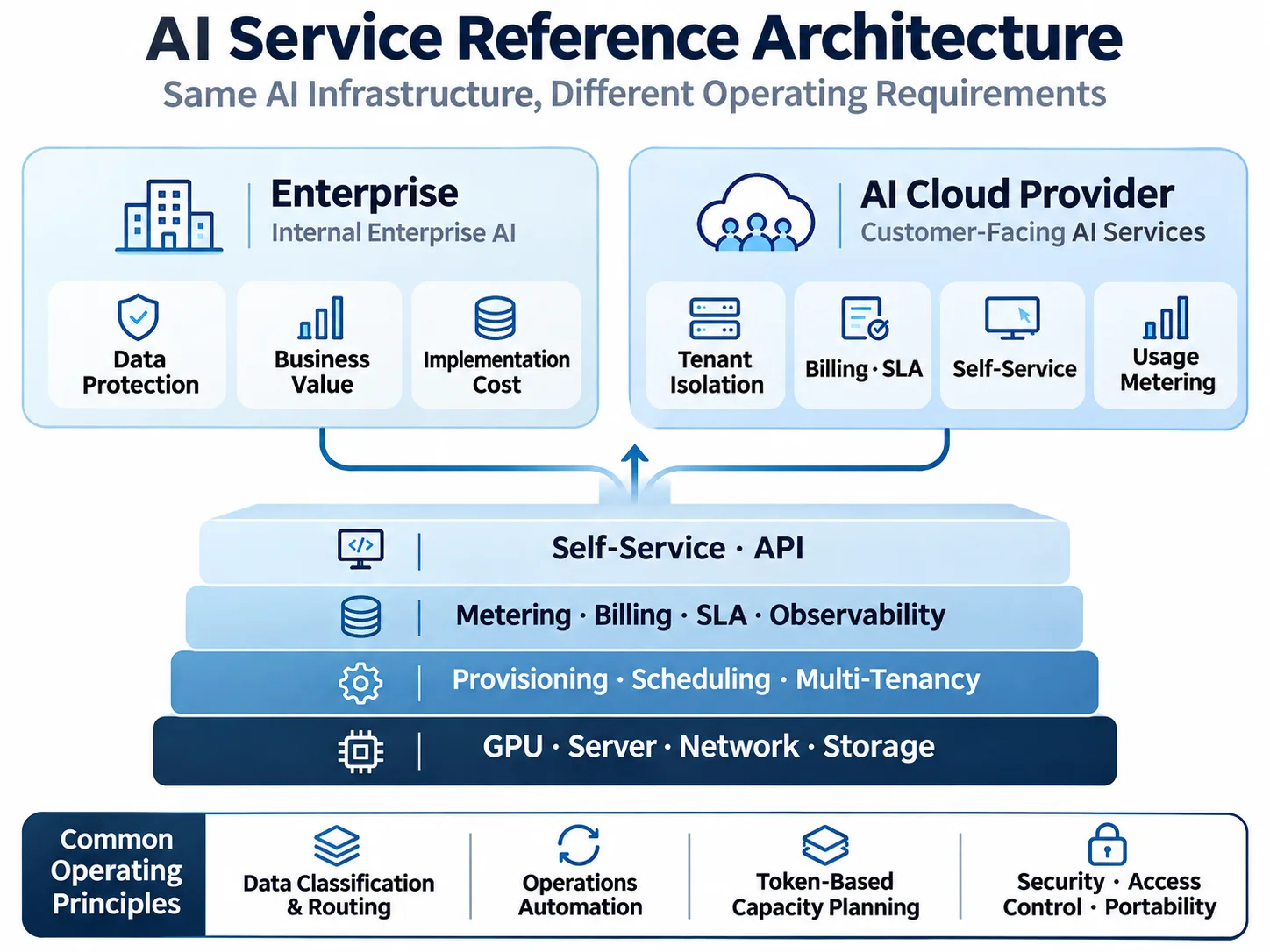
Thaki Cloud said the required operating model changes depending on how the AI environment is used, even when the underlying technology stack is similar. For an enterprise using AI internally, the primary considerations include business value, data protection and implementation cost.
The requirements become different when AI services are delivered to external customers. Tenant isolation, billing, self-service capabilities and service-level agreements move beyond internal operational concerns and become part of the customer service and contractual relationship.
The reference architecture therefore defines 10 additional requirements for AI cloud providers. These include tenant isolation, GPU utilization management, incident response, automated provisioning, auditable usage metering and billing, service-level agreements, self-service capabilities, and support for standard APIs and Infrastructure as Code. The framework also addresses different deployment models and the division of operational responsibilities between providers and their customers.
Turning AI infrastructure into a consumable cloud service
The AI cloud provider architecture is structured as a progression from underlying infrastructure to a service that customers can directly purchase and use. GPU, server, network and storage infrastructure forms the foundation, followed by provisioning, scheduling and multi-tenancy capabilities. Metering, billing, SLA management and observability sit above these infrastructure operations, with self-service interfaces and APIs connecting the platform to the customer-facing cloud service.
Thaki Cloud said owning GPU infrastructure alone is not sufficient to operate an external AI cloud service. Customer isolation, scheduling, usage metering, billing, SLA management, APIs and self-service capabilities are also required to turn infrastructure capacity into an operational service.
The architecture also proposes token-based capacity planning rather than relying solely on user counts. Expected token consumption per task and usage frequency can be used to estimate aggregate token demand, which can then be translated into required throughput and GPU capacity. For AI cloud providers, Thaki Cloud said the operating model should also consider cost per token, selling price and GPU utilization.
The reference architecture covers multiple deployment options, including shared cloud, dedicated environments, customer VPC integration, sovereign environments and on-premises deployment. It also treats portability as a design consideration, using standard APIs and Infrastructure as Code tools to reduce excessive dependence on a single environment.
Thaki Cloud emphasized that the AI Service Reference Architecture is not a product specification built around a particular Thaki Cloud offering. Instead, it is intended as a design reference that organizations can adapt according to their data characteristics, target users, infrastructure scale and operational responsibilities.
Seung-Hun Jeon, CTO of Thaki Cloud, said, “An AI service is not complete simply because an organization has secured GPUs and models. Even when the underlying AI infrastructure is similar, an environment used internally by an enterprise and one delivering services to external customers have different operational responsibilities and requirements. We developed this reference architecture to provide a practical way to consider the layers and design criteria required across data processing, infrastructure operations, billing, SLAs and self-service delivery.”
About Thaki Cloud
Thaki Cloud is a NeoCloud company founded in February 2025 and headquartered in Gangnam-gu, Seoul, led by CEO So-ryun Kang. The company focuses on Cloud Services optimized for GPU and AI computing, as well as On-premises Solutions that enable enterprises and organizations to operate AI within their own infrastructure.
Built on its proprietary cloud operations software and AI platform technologies, Thaki Cloud offers a range of products and solutions, including Velox, a Bare Metal GPU Cloud; Telox, a GPU & AI Cloud; and Paxis, an AI agent platform. The company also provides technologies and software stacks that enable telecommunications companies, data centers, AI infrastructure providers, and enterprise customers to build and operate AI services within their own environments, while also developing its own NeoCloud services.